The Death of Democracy by Benjamin Carter Hett
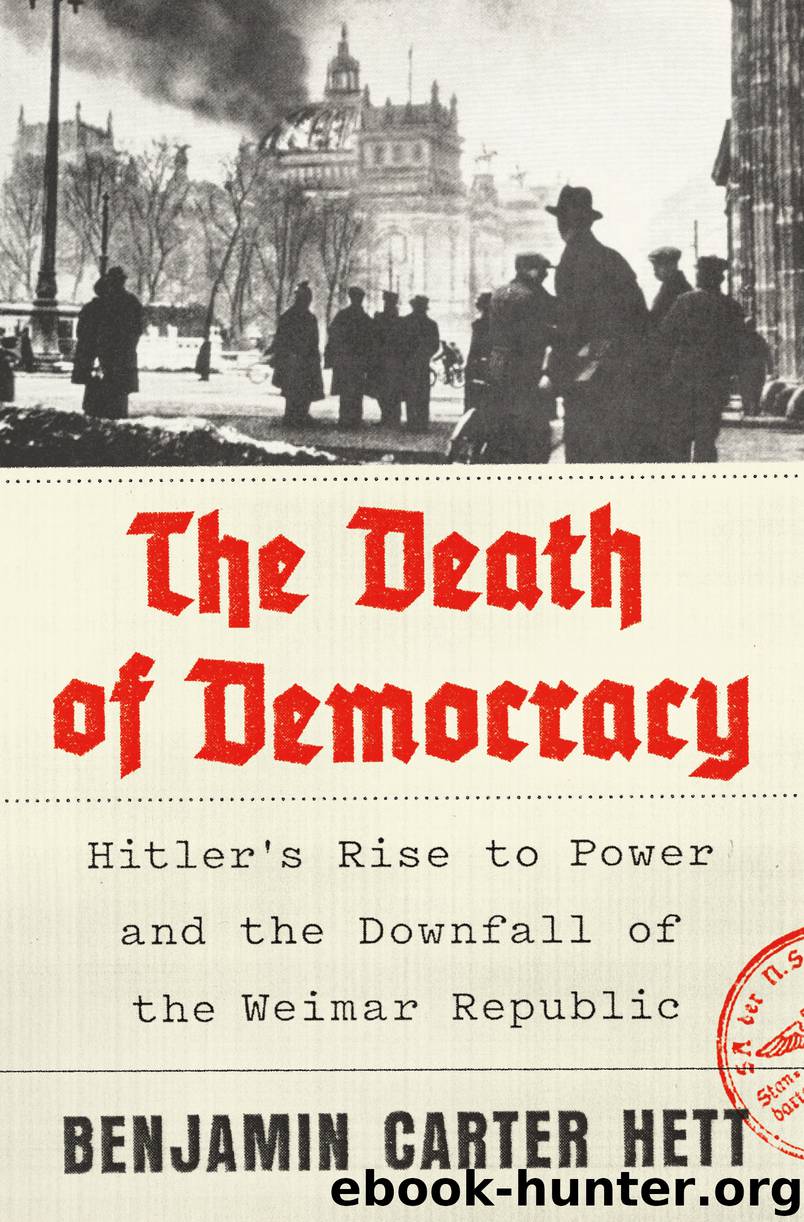
Author:Benjamin Carter Hett
Language: eng
Format: epub
Publisher: Henry Holt and Co.
6
The Bohemian Private and the Gentleman Jockey
Fifteen-year-old Melita Maschmann is drawn to the Nazis out of a desire to rebel against her parents. One day, at the end of January, the family’s dressmaker comes to the Maschmanns’ Berlin home to alter a dress for Melita. The dressmaker limps and has a hunchback. She wears a swastika under the lapel of her coat. Melita’s mother thinks it is presumptuous for working-class people to have opinions about politics, but the dressmaker tells Melita that things are changing. The day is coming, she says, when servants will no longer have to eat at the kitchen table, like inferiors.
That evening, Melita’s parents take her and her twin brother, Hans-Hermann, into the center of Berlin to see a parade. “Some of the uncanny feel of that night remains with me even today,” she will remember many years later. “The crashing tread of the feet, the somber pomp of the red and black flags, the flickering light from the torches on the faces and the songs with melodies that were at once aggressive and sentimental.”
Melita realizes that some of the young people marching are not much older than she is. She envies them, and yearns for their sense of purpose. Being a child forces her to live a life with no stakes, a life that doesn’t matter. The boys and girls in the marching columns in front of her matter. Melita notices they carry banners bearing the names of their dead.
She is not blind to the violence of the moment. She sees how suddenly one of the marchers breaks ranks to strike a spectator standing only a few feet away from her. She assumes the spectator made some kind of hostile remark. She sees him cry out and fall, with blood streaming down his face. Melita’s parents pull her away, but the image haunts her for days.
Yet she finds her horror is also mixed with an “intoxicating joy.” The young people marching with their torches sing of how they are ready to die for the cause. This is something far beyond Melita’s daily grind of “clothing or food or school essays.” She feels overcome “with a burning desire to belong to these people,” for whom it is “a matter of life and death.”
Many other Germans share Melita’s sense of exaltation on this night. Joseph Goebbels waits for the torchlight procession at the Kaiserhof Hotel. “It begins at about 7 o’clock,” he notes, and it goes on until after midnight. He has trouble finding words strong enough. “Endless,” he writes, “a million people on the march … Awakening! Spontaneous explosion of the people. Indescribable.”
Others are considerably more jaundiced. The conservative intellectual Edgar Julius Jung and the editor Rudolf Pechel watch the procession together with distaste. Finally, Jung turns to Pechel and says, “Isn’t it terrible how alone we are in this German people, whom we love so much.” The pithiest reaction comes from the great impressionist painter Max Liebermann, as he watches the marchers from the window
Download
This site does not store any files on its server. We only index and link to content provided by other sites. Please contact the content providers to delete copyright contents if any and email us, we'll remove relevant links or contents immediately.
| Africa | Americas |
| Arctic & Antarctica | Asia |
| Australia & Oceania | Europe |
| Middle East | Russia |
| United States | World |
| Ancient Civilizations | Military |
| Historical Study & Educational Resources |
Room 212 by Kate Stewart(5119)
The Crown by Robert Lacey(4814)
Endurance: Shackleton's Incredible Voyage by Alfred Lansing(4780)
The Iron Duke by The Iron Duke(4354)
The Rape of Nanking by Iris Chang(4211)
Joan of Arc by Mary Gordon(4109)
Killing England by Bill O'Reilly(4001)
Say Nothing by Patrick Radden Keefe(3984)
I'll Give You the Sun by Jandy Nelson(3446)
Shadow of Night by Deborah Harkness(3367)
Hitler's Monsters by Eric Kurlander(3341)
Mary, Queen of Scots, and the Murder of Lord Darnley by Alison Weir(3210)
Blood and Sand by Alex Von Tunzelmann(3203)
Eleanor & Park by Rainbow Rowell(3171)
Darkest Hour by Anthony McCarten(3129)
Margaret Thatcher: The Autobiography by Thatcher Margaret(3081)
Book of Life by Deborah Harkness(2938)
Red Famine: Stalin's War on Ukraine by Anne Applebaum(2932)
The One Memory of Flora Banks by Emily Barr(2863)
